POC App
A warehouse proof-of-collection app for SAP Business One supplier returns
01 - INSPIRATION
POC App came from a practical paperwork problem: supplier returns still needed signed collection evidence, but the proof lived outside the system that operators actually use.
The manual version was fragile. A courier signs paper, someone keeps track of the document, and SAP only knows the proof exists if a person updates it correctly later. That is exactly the kind of small operational gap that becomes annoying at volume.
The useful product shape was not a big warehouse platform. It was a lightweight app that sits beside SAP, captures the proof at the moment of collection, generates a clean PDF, and writes the right reference back to the A/P Credit Note.
02 - MY ROLE & CONTRIBUTION
I defined the MVP around the smallest flow that could be useful in a real warehouse.
That work included:
- choosing A/P Credit Note lookup on demand as the first workflow
- designing the flow around warehouse-owned devices and a shared PIN rather than courier accounts
- connecting the app to SAP B1 Service Layer for document lookup and UDF writeback
- adding SQL Server persistence for local document state, lines, signed timestamps, and generated proof links
- generating proof-of-collection PDFs with supplier, document, returned-item, totals, driver, and signature details
- hardening the private deployment behind the trusted network with a user-level service and encrypted runtime config
- iterating the UI into a warmer Spark Palette direction after the functional flow was proven
The project stayed deliberately focused. It does one job and makes the evidence easy to see from SAP.
03 - POC APP SYSTEM
Warehouse Layer
Application Layer
SAP + Data Layer
Output Layer
04 - PRODUCT SCREENS
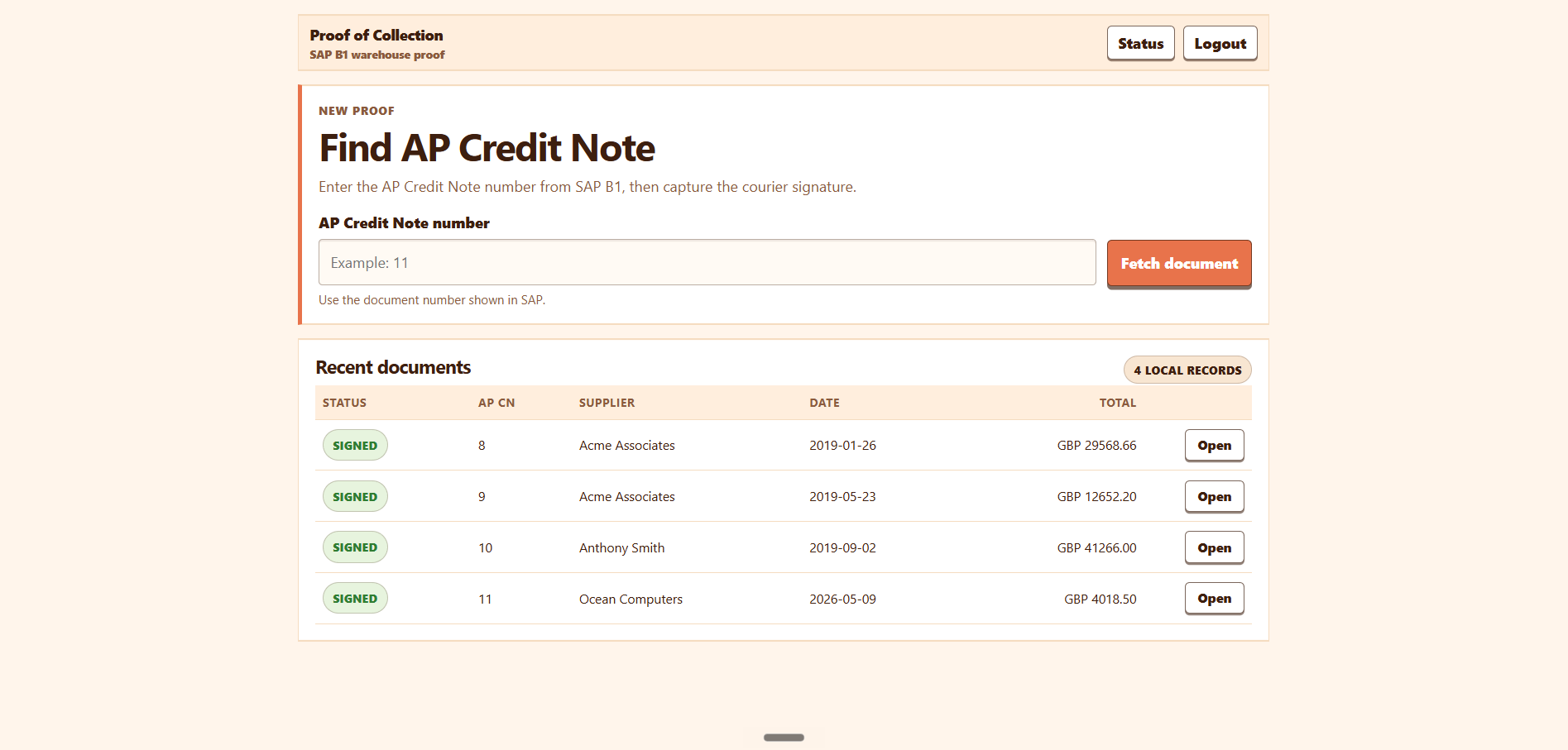
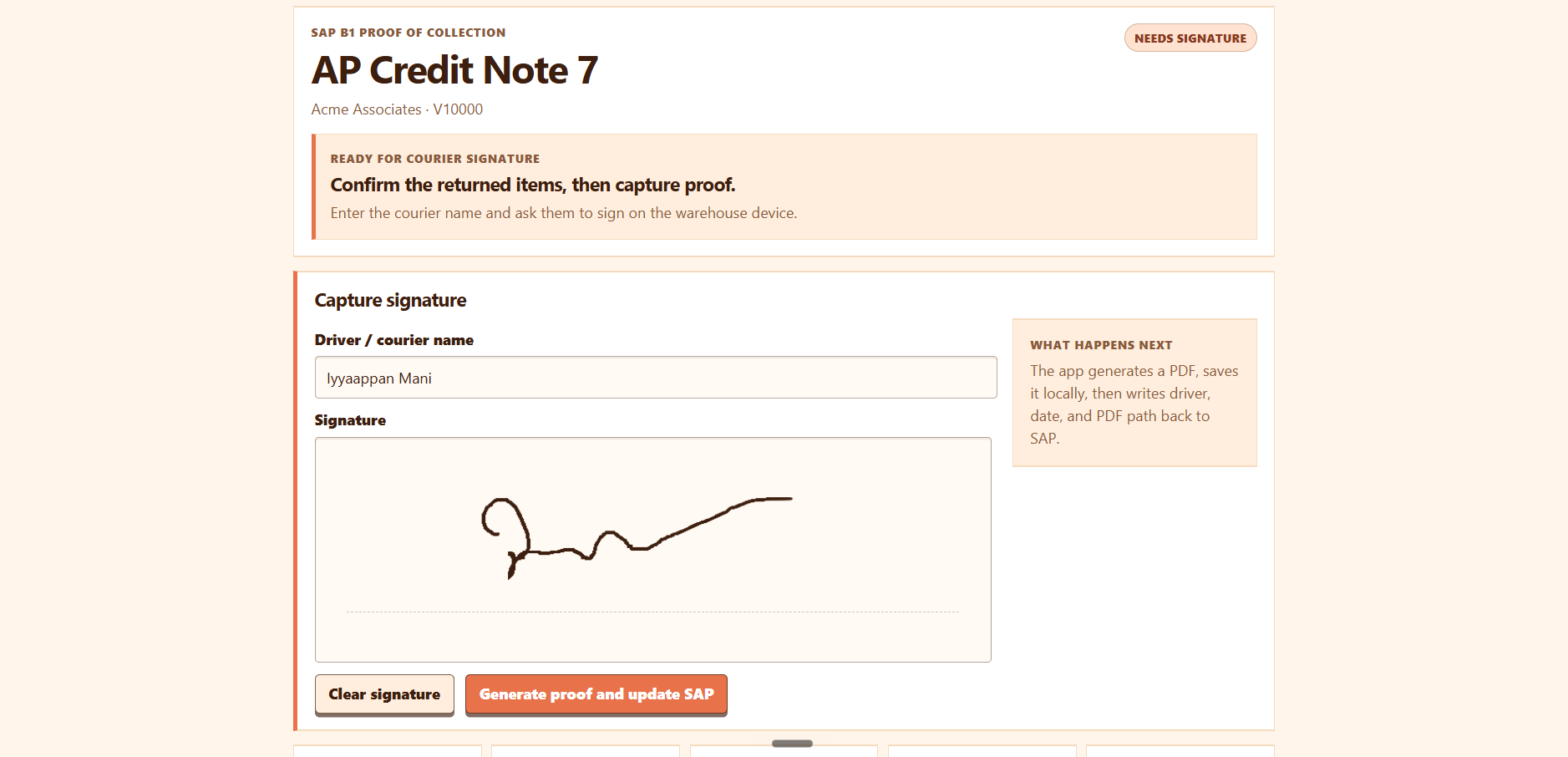
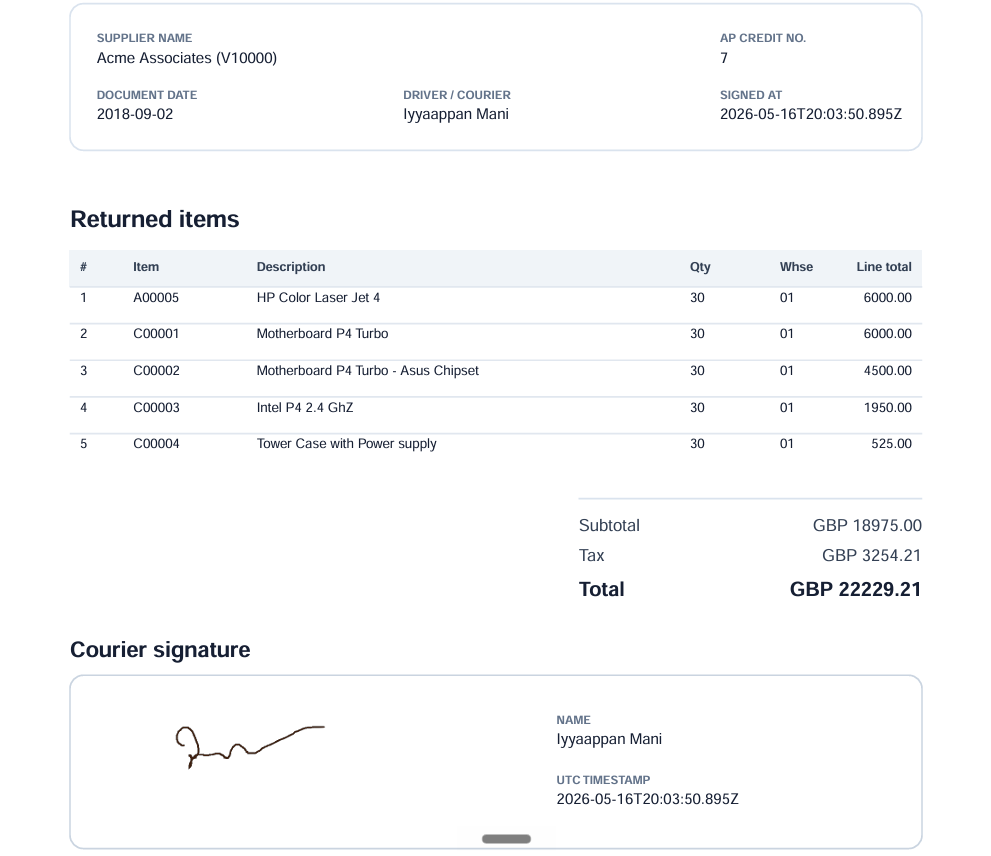
05 - TOOLS USED
POC App combines a small web app, SAP integration, document generation, and private deployment.
- Node.js / TypeScript for the Fastify application and domain logic
- SAP Business One Service Layer for A/P Credit Note lookup and UDF writeback
- SQL Server for app-owned proof records and returned-item snapshots
- PDFKit for proof-of-collection PDF generation
- EJS + browser JavaScript for the warehouse signing interface
- Trusted-network systemd service for private internal access
- Encrypted runtime vault for SAP, SQL, auth, and deployment secrets
The stack is practical because the app has to bridge physical workflow, SAP data, proof storage, and operator trust without becoming a heavy product.
06 - CHALLENGES AND HOW I SOLVED THEM
The first challenge was SAP access. SQL showed A/P Credit Notes existed, but Service Layer initially returned no rows and blocked direct access. I treated that as an authorization problem rather than guessing around the API, then retested once the SAP user permissions were corrected.
The second challenge was proof ownership. The app needed to store enough local state to render and audit signed proofs, but SAP still had to remain the operational source where users find the final reference. I solved that by storing local documents and PDFs while writing only the driver, signed date, and proof URL back to SAP UDFs.
The third challenge was making a small app feel trustworthy. A plain form would technically work, but warehouse users need clear status, obvious actions, and a readable signed state. The UI was redesigned around warm command panels, tactile buttons, a clear top bar, explicit status pages, and a signature-first document flow.
The fourth challenge was PDF quality. Early generated proofs had layout issues and a blank trailing page. I tightened spacing, aligned columns, simplified footer handling, and kept the normal proof on one page.
07 - WHAT I LEARNED
POC App reinforced that small internal tools still need product discipline.
The strongest lessons:
- a narrow workflow can be more valuable than a broad platform when it closes a real operational gap
- SAP integrations need permission and entity checks before UI assumptions
- signed evidence should be easy to find from the system users already trust
- private tools still need good interaction design because bad UI creates bad operational data
- PDF generation is product work, not just output formatting
The project is a good example of pragmatic automation: capture the proof once, store it safely, and make SAP point to the result.
08 - HOW AI SUPPORTED THE WORK
AI helped accelerate the build, test planning, UI iteration, PDF layout passes, and deployment checks. It was useful for turning a rough workflow into implementation steps quickly, then tightening edge cases as they appeared.
The important decisions still came from operational judgment: keep the MVP narrow, avoid unnecessary courier accounts, write only the required UDFs back to SAP, keep secrets encrypted, and make the UI warehouse-friendly rather than flashy.
09 - CURRENT STATE
POC App is live as a private internal pilot behind the trusted network. It runs as poc-app.service, uses encrypted runtime config, requires a shared warehouse PIN, and exposes health/status checks for SQL, SAP Service Layer, A/P Credit Note access, and PDF storage.
The end-to-end flow has been proven against SAP demo data: lookup an A/P Credit Note, capture a courier signature, generate a one-page proof PDF, store the local record, serve the proof URL, and write the proof fields back to SAP.
That makes it a strong portfolio project because it shows applied AI-era product building in a very grounded environment: not a chatbot, not a demo page, but a small operational app that joins SAP, warehouse work, and signed evidence into one usable flow.